
Street Commodores // Workshop Journal
Sample-to-Bulk Handover on an Export Order: What to Recheck
The handover from an approved sample to a bulk export order is where a subscription brand's assumptions get tested, because almost nothing that was true of the sample stays automatically true of the bulk. Quantity, pack, batch, artwork, documentation and shipping terms all become concrete at the same moment. A brand that treats handover as a formality usually discovers the gap at the port, and discovers it at the least convenient hour. A brand that treats it as a recheck discovers the same gap in an email, three weeks earlier.
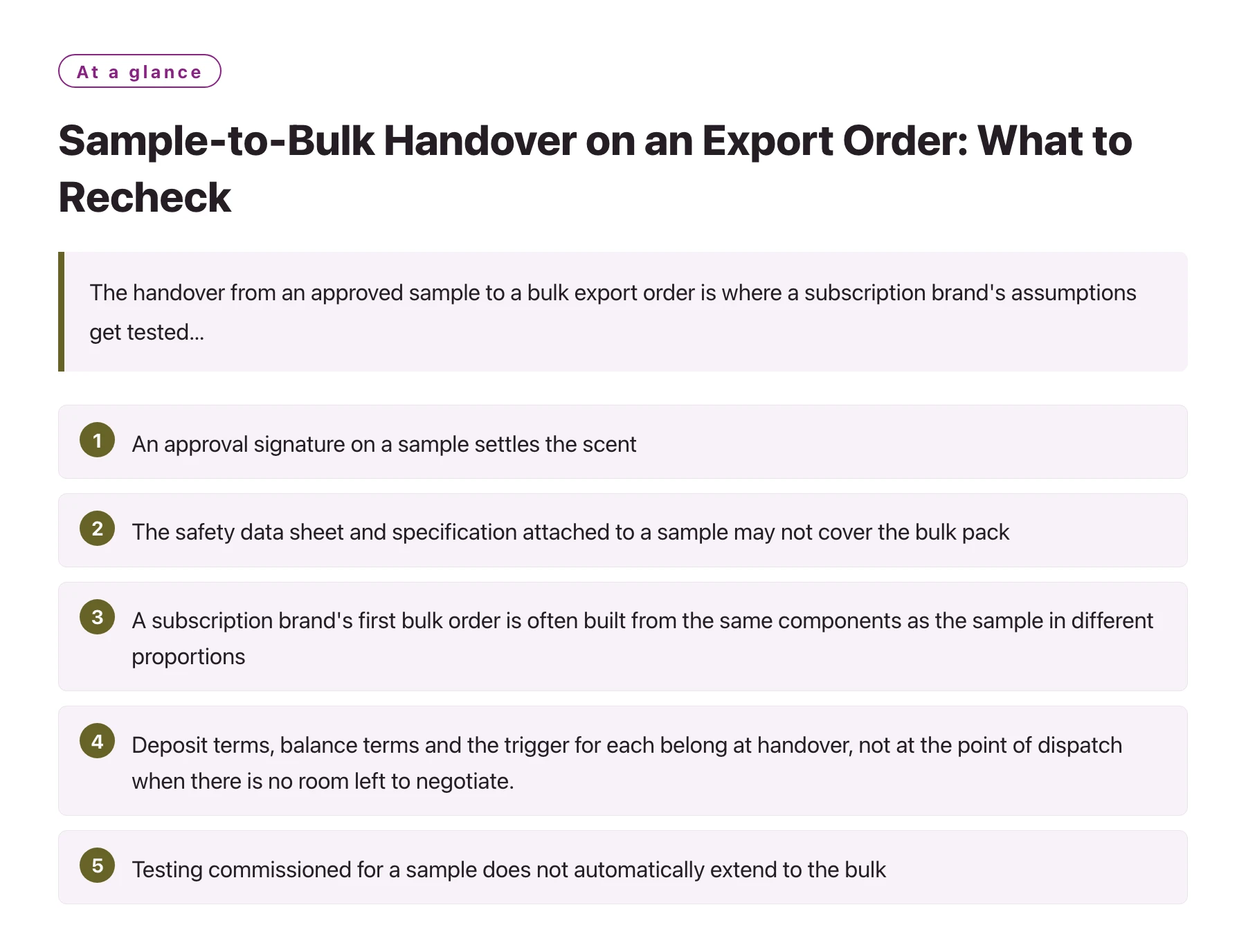
Key takeawaysAn approval signature on a sample settles the scent, not the export; quantity, pack format, batch numbering and paperwork are decided separately at handover. · The safety data sheet and specification attached to a sample may not cover the bulk pack, so destination documents should be reissued rather than reused. · A subscription brand's first bulk order is often built from the same components as the sample in different proportions, which is exactly the kind of change that moves a customs declaration. · Deposit terms, balance terms and the trigger for each belong at handover, not at the point of dispatch when there is no room left to negotiate. · Testing commissioned for a sample does not automatically extend to the bulk, so the schedule should name which checks are repeated and when [1].
There is a comfortable story about how a fragrance order works: a sample is approved, the factory makes more of the same thing, and the boxes arrive. The story is roughly true about the liquid and almost entirely false about everything around it. Export paperwork does not care that the scent was approved. It cares what is in the pack, how much of it is in there, which batch it came from, and which market it is being placed on.
The handover is the moment those questions stop being theoretical. It is also the last moment when changing an answer is cheap. Once production is scheduled and a sailing is booked, every correction carries a cost, and the cost is usually paid in days rather than money.
What follows is a recheck list, not a procedure. The point is not to duplicate the factory's own controls but to confirm the handful of things that only the brand can confirm, because only the brand knows where the product is going and who is going to sell it.
What an approved sample actually settles
An approval settles one thing well: the target. It establishes that this particular interpretation of the brief is the one the brand wants, and it creates a moment that the rest of the project can be measured against. Everything else that people assume the approval covers, it does not.
The scent and the reference standard
A signed approval sheet is not a reference standard. The reference is a physical retained sample of the approved batch, kept under conditions where it will not change, and identified by batch and date. Without it, the first bulk delivery will be compared against someone's memory, and memory is a generous standard in the weeks after approval and a harsh one six months later.
Ask where the retained reference lives and how long it is kept. A supplier that keeps references as a matter of routine will answer immediately. A supplier that does not will offer to find the sample, which is a different kind of answer.
What the approval never covered
Approval covers a scent in a container. It does not cover the pack the bulk will ship in, the number of units per carton, the batch coding, the artwork version, the language of the label, or the documents that will travel with the goods. Each of those is a separate decision, and each of them can change after the sample stage without anyone thinking to reopen the approval.
This is where working with the perfume manufacturer behind it the perfume manufacturer behind it becomes practical rather than promotional. A manufacturer that exports regularly will have a handover document of its own, and the useful move is to read it before the meeting and mark the lines that are silent. Silence on a handover sheet is where the expensive surprises live.
Documents that have to be reissued, not reused
The safety data sheet that was supplied with the sample describes the material that was supplied with the sample. If the bulk arrives in a different pack size, a different concentration, or as part of a finished retail unit rather than a development sample, the sheet is no longer describing the thing that is moving [1]. Reissue it rather than editing the date on the old one.
The same logic applies to the specification and the ingredient breakdown. A specification written for a development sample often lists the concentrate and nothing else. The finished product that will be placed on a shelf has a pack, a label and a set of declarations, and those need to be reflected in the file that accompanies the shipment.
The subscription wrinkle
A one-off order needs one document set. A subscription needs a document set that stays true across a run of batches. Each month brings a new batch, and each new batch should bring its own certificate of analysis, tied to the batch code on the cartons. A brand that collects these from the start has a paper trail that takes minutes to assemble when a retailer or a customs broker asks. A brand that collects them retroactively never quite catches up.
It is worth deciding at handover who stores the certificates and how long they are kept. The answer is usually dull, which is a sign that it is the right answer.
Pack, batch and quantity change the declaration
Customs declarations describe physical goods, not intentions. Moving from a development sample to a bulk order changes the physical description: the fill volume, the number of units, the packaging materials, and often the concentration. Any of those can move the classification or the licence position attached to the shipment.
This is also the stage at which the difference between two orders of the same fragrance becomes visible. Two bulk runs can be identical in formula and differ in the ways that matter to a declaration, which is a good reason to understand why a sample and the bulk order can differ why a sample and the bulk order can differ before the first shipment rather than after it.
The practical check is simple. Read the draft commercial invoice and packing list, and compare each line against what will actually be in the carton. Quantities, unit values, weights, and the description of the goods should match the physical reality, because a mismatch between the document and the box is the single most reliable way to turn a routine clearance into an inspection.
Commercial terms belong in the handover meeting
Handover is also when money changes shape. A sample may have been supplied free, at cost, or as part of a development fee. The bulk order has a price, a deposit, a balance trigger and a delivery window, and each of those needs to be attached to a specific event rather than to a general expectation of progress.
The subscription model adds one question that a one-off order does not have: what happens if the cadence changes. Subscriber numbers move, and a brand that committed to a fixed monthly volume may need to reduce or pause. The handover is the moment to agree how a volume change is handled, because renegotiating that during a production month is far more expensive.
It is worth confirming as well who owns the retail unit itself. A brand buying private label fragrance production private label fragrance production should be clear about which party holds the packaging specification, the artwork files and the label content, so that a future change of supplier does not require rebuilding all three from memory.
The most useful question at any handover is the least glamorous one: what will be true of the bulk that was not true of the sample? If the answer takes more than two minutes to produce, the handover has not happened yet.
Sources
- SGS: Cosmetics, Personal Care & Household Testing —— Testing, inspection and certification services for cosmetics and personal care, including microbiological, stability and safety testing aligned with cosmetics GMP.
Frequently asked questions
Should a brand approve a sample before agreeing export terms?
The two can run in parallel, and often should, because export terms take time to settle with a forwarder. What matters is that the approval does not become the reason a term is left unagreed. Approve the scent, then immediately confirm pack, volume and destination while production is still being scheduled.
Who pays for an updated safety data sheet or specification at handover?
It depends on what changed and why. A supplier updating a document because the pack changed on the brand's instruction will usually charge for the work, and a brand should expect that. A supplier updating a document because its own material changed should not.
How many retained reference samples should be kept?
Enough that both sides hold one and a third is available for a dispute. The important detail is not the count but the identification: a reference without a batch code and a date is a souvenir rather than a standard.
Does a deposit protect a subscription brand?
A deposit reserves capacity and materials, which is real value in a busy factory. It does not by itself define what happens if the cadence changes, so the terms around volume variation matter as much as the deposit percentage.
What is the biggest mistake at this stage?
Treating handover as an administrative formality and sending it to whoever is available. The decisions made there, particularly around pack, documents and volume flexibility, are the ones that are hardest to reverse later.