
The 48-Hour CAD Stage in OEM/ODM Jewelry Work
Under 48 hours is the whole cost of the CAD stage on an OEM/ODM order: a technical drawing plus renderings you approve on a screen. It is the least costly revision window in the project, because the moment it closes the 25–30 day sampling block opens and every further change is paid in bench time. Packaging lines, by contrast, are usually locked in with the CAD file so the carton is not the last thing anyone thinks about.

Key takeaways
- The CAD stage delivers a dimensional drawing and renderings inside 48 hours, before any metal is cut.
- Master sampling then runs 25–30 days and mass production 3–4 weeks, so CAD is roughly 7% of the sampling clock.
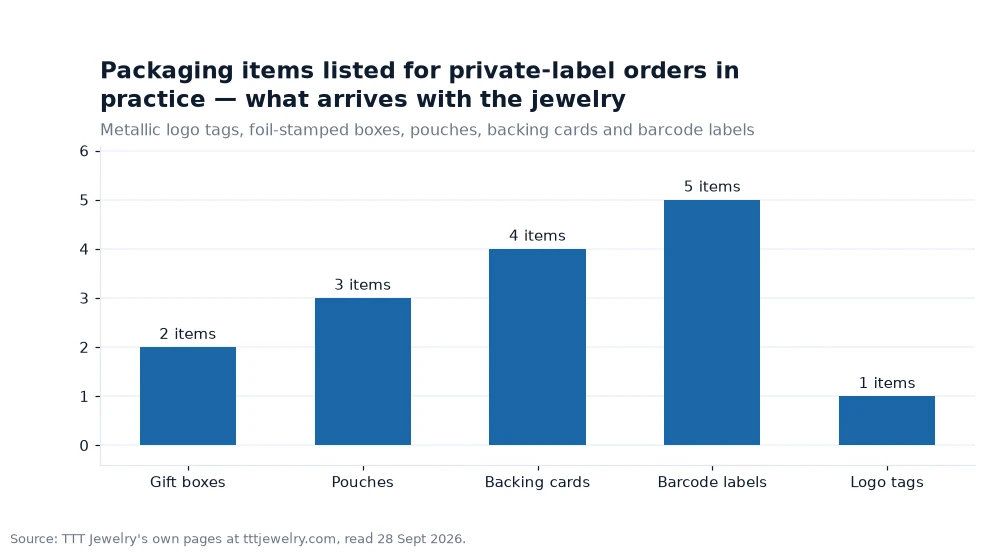
- Five packaging lines are offered on private-label orders, from metallic logo tags to barcode labelling.
- Hallmarks are laser engraved with the logo, using 18KGP on gold-plated work, 316L for stainless steel and an S925 stamp according to base metal.
What lands in your inbox when the CAD stage closes
Two things: a technical drawing with the dimensions the bench will work to, and a set of realistic renderings that show how the finished piece will read in the hand. Both arrive inside 48 hours of the brief, and both exist to be argued with. This is the sign-off where you confirm stone size, band width, bail thickness and how the plating will sit over a textured surface.
The value of approving a rendering is that a mistake on screen costs nothing but a reply. The same mistake discovered after mould casting costs a mould, a wax print and a week of the sampling window.
Why this is the least expensive place to change your mind
Compare the two revision paths. A change requested during CAD is a redraw: the designer moves a curve, re-renders, sends it back, and the 48-hour figure usually still holds because the drawing is screen work. A change requested after the sample arrives means a new mould or a re-set, and the piece has to travel through wax printing, casting, stone setting, polishing and electroplating again.
That asymmetry is the reason an OEM jewelry manufacturer puts the CAD file in front of you before tooling and not after. Treat the rendering as the last free decision in the project and it stops being a formality.
The packaging lines that ship with a private-label order
Packaging is the sixth customisation group and the one buyers most often decide late. It does not change the metal, but it does change the packing bench, so it belongs in the same window as the CAD approval. The published list covers five lines, and each one carries a different job.
| Packaging line | What it does | Decided with |
|---|---|---|
| Metallic logo tags | Ties the piece to your brand at first touch | Logo artwork and hallmark |
| Foil-stamped gift boxes | Retail presentation for a boxed sale | Box size, which follows the piece |
| Velvet or microfiber pouches | Soft storage and lower shipping volume | Pouch size and fabric draw |
| Display backing cards | Holds earrings and pendants square on a rack | Card stock and printing |
| Barcode labelling | Warehouse and marketplace scanning | SKU list, one code per design |
Worked example: labelling 50 pieces and timing 48 hours
Take the published silver minimum of 50 pieces per design. If a design ships with a logo tag, a backing card and a barcode label — three of the five packaging lines — then 3 × 50 = 150 printed items run alongside those 50 pieces. Add a gift box and pouch per piece and it becomes 5 × 50 = 250 packing items, which is why packaging is quoted as a line rather than absorbed.
For the timing side, the sampling window at its outer published edge is 30 days, which is 30 × 24 = 720 hours. The CAD stage at 48 hours is therefore 48 ÷ 720 = 0.067, about 6.7% of that window. Both sums are my own; 50 pieces, 48 hours and 25–30 days are the published figures.
What to check in the rendering before you approve it
Finish options are an anti-tarnish e-coat on silver and brass, rhodium, gold at 14K, 18K and 24K and vacuum PVD plating for steel.
Check those four on screen and the sample window does what the schedule says. Leave them to the sample and you spend the window twice.
When the CAD stage takes longer than two days
Forty-eight hours is the published turnaround for a brief that arrives complete. If your sketch is ambiguous — a ring drawn without a band thickness, a pendant with an unclear bail — the designer has to ask questions before drawing, and questions stretch the window. Sending a sketch with dimensions, a material choice and a target piece count in the first message is the fastest way to keep the 48 hours at 48 hours.
Who sees the CAD file, and for how long
An approved drawing does not circulate. The file is used by the CAD team, then by the wax printing and casting benches, and it stays with your account — moulds, CAD files and the developed collection are not resold, not shown to other buyers and not published as a house design. That is covered by the same 100% NDA that applies from the first exchanged document, and it applies whether you arrived with your own file or asked the design team to draw one.
Practically, that means two questions are worth asking in the first exchange: who inside the workshop can open the file, and what happens to it if you move a design to a different supplier later. A factory that answers both in one reply is showing you its document routine rather than its sales pitch.
Frequently asked questions
Is the 48-hour CAD file enough to start production?
No. The drawing and renderings are for dimensional approval only; production starts after the master physical sample is approved, which takes 25–30 days.
Can I ask for packaging changes after the CAD stage?
Yes, and buyers usually do. Packaging sits outside the metalwork, so foil-stamped boxes, pouches, backing cards, logo tags and barcode labelling can be adjusted while the sample is being built.
What file formats does the design team accept?
Hand drawings, reference photographs, a competitor piece with notes, or a tech pack all work as inputs; the CAD team turns any of them into a dimensioned drawing and renderings inside 48 hours.
Using the drawing as the control point for the order
The CAD approval is the document every later argument refers back to. When the sample arrives, nobody debates taste — the question is whether the piece matches the approved drawing, which is a question with a yes or no answer. That is what makes the second and third orders repeatable.
Builders who want the intake side in writing should read what a factory visit covers before sending files, and if the first order is a plated fashion line rather than a precious metal one, the stainless steel route has different tooling and a 100+ piece minimum worth knowing before you draw.
What this article works from — laser engraving for logos and the eight production stages plus the approved-sample benchmark — is written up at the manufacturer's own pages at tttjewelry.com (read 28 Sept 2026). The quality system is backed by ISO 9001:2015, also published there. No figure above is estimated. The comparisons drawn from those figures are mine alone [1]